Pages

Thursday, December 9, 2010

How the Grinch Stole Christmas - Roast Beast


"They would feat on Who-pudding, and rare Who-roast-beast
Which was something the Grinch couldn't stand in the least!" - How the Grinch Stole Christmas, Dr. Seuss


How the Grinch Stole Christmas!

That's right. I made a roast. I really had to ask myself: does the novelty of making something called "roast beast" make up for the fact that making it is an elaborate and time consuming affair? And the answer is yes. I make a roast like twice a year so I might as well make it now.

I hope everyone is familiar with Dr. Seuss' How the Grinch Stole Christmas. If you aren't familiar with the book then surely you are familiar with the animated cartoon version that airs on television every year around this time. It's a holiday classic. But if you need a refresher...

The Grinch is a surly kind of guy who hates Christmas and all of the happy citizens in Who-ville who love it. (Clearly, he is just lonely and misunderstood and only acts out to mask his pain.) While grousing about how much he hates the season he is struck with inspiration: he will prevent Christmas from coming! He puts his plan into action and soon is sneaking into each home on Christmas Eve to make off with all of the Christmas trappings. But something goes wrong. As the Grinch is congratulating himself on Christmas morning, he realizes he can hear singing coming from Who-ville. Despite his best efforts, he hasn't ruined Christmas at all. The Whos may not have presents or decorations but they have each other and the Grinch is stunned to realize spirit of Christmas comes from within. He begins to have second thoughts about what he has done. Filled with the Christmas spirit, his heart grows "three sizes" and he returns to town to return all of the things he has stolen. He even presides over Christmas dinner, where he carves the roast beast. Awwww.

Obviously, we had to make roast beast in honor of the Grinch. Knowing Dr. Seuss the roast beast is probably some sort of moose or mammoth or something (the picture leaves it open to interpretation) but for our purposes I decided it was beef.

Roast Beast (really Ina Garten's Company Pot Roast)
(I did not follow Ina's recipe to the letter. What follows is my interpretation of the original recipe.)

(Ignore the tomato paste--I purchased it for a different meal and it somehow ended up in the picture)


Ingredients:
  • 3 lb. (the recipe recommends 4-5 pounds) boneless beef chuck roast
  • Kosher salt and black pepper
  • flour (Pamela's gluten-free bread mix/flour blend)
  • olive oil
  • 2 cups chopped carrots
  • 2 cups chopped yellow onion
  • 2 cups chopped leeks
  • 5 large garlic cloves, crushed
  • 2 cups red wine
  • 2 tablespoons brandy
  • 1 can diced tomatoes
  • 1 cup chicken stock
  • 1 chicken bouillon cube, or equivalent
  • 3 branches fresh thyme
  • 2 branches fresh rosemary
  • a tablespoon unsalted butter, at room temperature
Additional equipment: French oven (sometimes called a Dutch oven), immersion blender (or food processor).

The first thing you should know is that this is a fairly elaborate undertaking. Be prepared to spend some time in the kitchen. The cook time alone is 2+ hours. Fortunately, once you have everything in the oven you can ignore it for awhile.

1. Preheat oven to 325*. While oven is heating chop your vegetables. I always chop mine and throw them in a large bowl, then set aside for later.

2. Season the beef with salt and pepper. Dredge in flour (making sure all sides are covered).

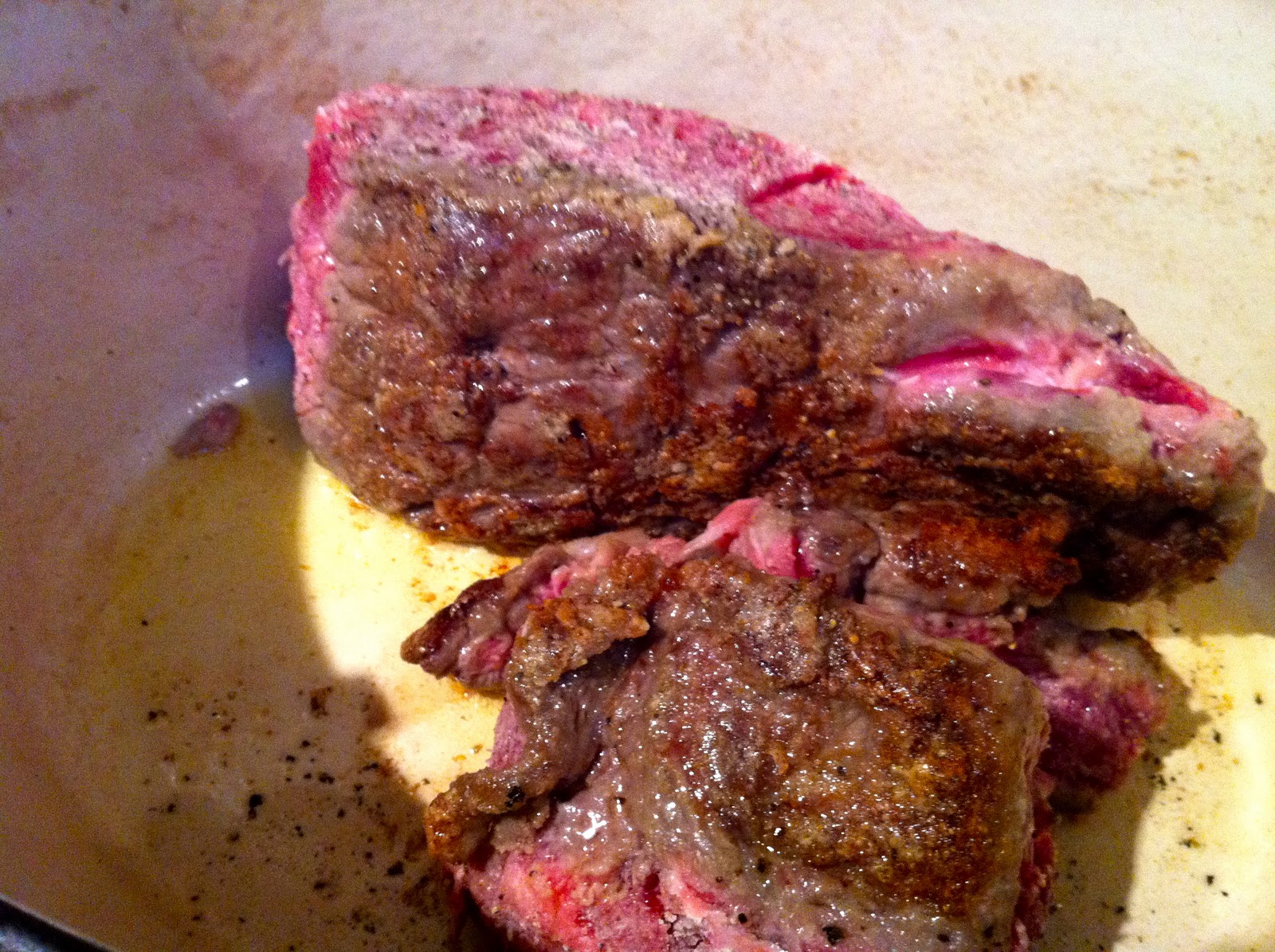
3. On the stovetop, heat 2 tablespoons of olive oil in the French oven. Sear meat on all sides, then remove and set aside.

The meat, mid-sear
4. Add 2 more tablespoons oil to the French oven. Add vegetables and garlic and cook until softened.


5. Add wine, brandy, tomatoes (with liquid), chicken stock, bouillon, rosemary, and thyme. Once boiling, place the meat in the French oven. Cover, remove from stovetop and place inside oven for about 2.5 hours, or until meat is fork tender. About an hour into the cook time turn heat down to 250*.


6. When meat is finished cooking, remove from oven. Place meat on a separate plate. Remove the herbs and discard. Remove about half of the liquid and veggies and place in a separate bowl. Puree using an immersion blender (or food processor) and return to French oven. Place on the stovetop and let simmer on low heat. While simmering, mix butter and 2 tablespoons of flour together and add to pot. Let sauce simmer until thickened.

7. Serve meat with sauce and veggies on top. I served toasted garlic parmesan bread alongside the meat.


This meal takes a long time to cook but the results are well worth it. While it was in the oven my kids complained that they just wanted something else for dinner, but as the aroma permeated the house they began to get excited about the "roast beast". I think they set a new record for the number of times "roast beast" can be uttered in one evening. "The roast beast smells good."  "I can't wait to try the roast beast." Obviously, changing the name of an old dish somehow makes it taste better; I can't imagine they would have been so excited over plain old pot roast.

And really, this is much better than plain old pot roast. The addition of the wine and adding the puree at the end really classes it up and gives it a rich, velvety flavor. I don't think I can go back to making pot roast in my crock pot after having it this way. Even if it does require a little more effort.

Wednesday, December 1, 2010

The Latke Who Couldn't Stop Screaming - Sweet Potato Latkes

"'I'm not part of Christmas!' cried the latke. 'It's a totally different thing!'" - The Latke Who Couldn't Stop Screaming, Lemony Snicket

The Latke Who Couldn't Stop Screaming: A Christmas Story


I like the holidays. They may be my favorite time of year. I love holiday treats, holiday music and favorite holiday specials. I love the smell of California mornings on cold (but not too cold) days in December and all the ways my husband and I plot to surprise our kids on Christmas morning. As we head into December I plan to feature many of my favorite holiday books here on the blog. At this time of year "holidays" are usually synonymous with "Christmas" so yes, I will be writing about Christmas (as well as general winter) books. But tonight is the first night of Hanukah, so I find it only appropriate to acknowledge the holiday with one of the funniest holiday books I have ever read: The Latke Who Couldn't Stop Screaming.

The Latke Who Couldn't Stop Screaming is written by Lemony Snicket (illustrated by Lisa Brown). If you are at all familiar with his Series of Unfortunate Events books, you know that this isn't going to be your typical heartwarming holiday yarn. If you were totally turned off by Pierre and Monsters Eat Whiny Children in my last post, this may not be the book for you. If you dig slightly deranged holiday tales, read on.

A latke is a potato pancake made from shredded potatoes and cooked in oil. It is commonly served as a part of Hanukah celebrations. As a holiday symbol, it is not as flashy as Christmas lights or as sweet as candy canes. And our titular latke, who has jumped out of a pan of boiling oil and run away, is frustrated--because none of the other holiday symbols he meets really understand what he is or how he fits into Christmas. He explains to each one, as he meets them, that he is not "hash browns" and not a part of Christmas. And that what he is a part of--Hanukah--is not Christmas. He relates the story of Hanukah to the Christmas lights, a candy cane and a pine tree as he encounters them (all the while growing increasingly--and hilariously--angry that they don't really get it). Finally, after he has slumped under a pine tree in frustration, he is found by a family. A Jewish family who recognize him immediately and want to make him a part of their Hanukah dinner.

This book is great because it works on two levels. I have Jewish friends who really do feel the way the latke does during the Christmas season: frustrated with the constant barrage of Christmas and the ignorance of some people who really don't understand that Hanukah isn't "Jewish Christmas" simply because it is celebrated during the same time of year. But it's also a book for those who want to learn more about Hanukah and understand, through the latke, why their Jewish friends might be so frustrated during this time of year.

Our angry latke, as illustrated by Lisa Brown
After reading the book together my kids, of course, wanted to make latkes. Which had always been my plan.

Sweet Potato Latkes with Applesauce and Eggs


Brown's illustrated latke-making instructions


This meal went through several revisions before it became what you see in the pictures. At first I had planned to make my latkes using frozen shredded potatoes. Not because I wanted to take the easy way out but because my husband is of the opinion that frozen potatoes fry up better than fresh. And I usually defer to him because he is the more skilled cook. Then my seven year old asked if I could make sweet potato latkes instead (he has a friend at school whose family makes them this way). I had not considered this at all. However, my seven year old has a deep hatred of shredded potato products. To the point that two nights ago he got himself so worked up over the apparent horror of tater tot casserole that he actually vomited. In my kitchen. Not wanting a repeat of this scenario, I acquiesced and resigned myself to the fact that I would be making sweet potato latkes from scratch. Though I did add in some frozen shredded potatoes to balance out the sweetness of the sweet potato.

Then I ran into the problem of what to serve with the latkes. Finally, buried deep on the third or fourth page of Google results (search term: "what to serve with latkes") was a Smitten Kitchen post in which fried or poached eggs were offered as a suggestion. Having just purchased eggs, I decided this sounded like a fabulous idea.

"But can we use the Mickey Mouse egg molds?" my seven year old asked.

So there you have it. Sweet potato latkes with applesauce and Mickey Mouse shaped fried eggs. I'm still not sure what Mickey Mouse has to do with Hanukah but seeing as how we aren't even Jewish to begin with I guess we'll let it go.

Ingredients:
  • shredded sweet potatoes
  • shredded frozen potatoes
  • shredded yellow onion
  • olive oil for frying
  • applesauce
  • fresh eggs
  • 4 tablespoons flour (I used a gluten-free flour blend)
  • pinch of cayenne pepper
  • pinch of salt
1. Peel your sweet potatoes and grate using a box grater. I started with three potatoes and used two. Wrap shredded potatoes in paper towel to wring out the moisture. Put the shredded sweet potatoes in a large mixing bowl.


2. Add frozen shredded potatoes to the mixing bowl. About 2/3 of my mixture was sweet potato and 1/3 was the regular potatoes. Mix together.


3. Using the grater, grate the onion into the mixing bowl. Add two eggs, salt, cayenne pepper and flour and combine with the potatoes.

4. Heat your olive oil in (preferably) an iron skillet. When the oil is hot drop small scoops of potato mixture in the skillet. Use the back of a spatula to flatten the latkes. Let cook on medium heat for 5 minutes on each side. I got better at this with each batch. The first ones were kind of fell apart because I didn't cook them long enough.


5. As you remove your latkes from the skillet, place on paper towels to absorb the excess oil. I made stacks with paper towels in between each latke layer.


6. Either simultaneously or after the latkes are finished cooking, make the eggs. I had to wait until the latkes were done because we only have one iron skillet and the egg molds don't work well in our other pans.


7. Serve your latkes and eggs with applesauce and/or sour cream.


I thought my sweet potato latkes were delicious (my husband thought they were too sweet and would have preferred using regular potatoes) and I take it as a good sign that my kids asked if they could take the leftovers to school for lunch. 

Happy Hanukah, to those of you who are celebrating tonight!

Monday, November 22, 2010

Cautionary Tales for Disobedient Children

Oh, subervsive cautionary tales in the guise of children's books--how I love you. Really, I do.  Maybe it's because when I was a child my cousin and I would spend the night at my Poppa's house; if we didn't go to sleep right away he would sneak outside and bang on the window with a stick and yell that he was the Boogeyman, there to "get" us. (You have to understand, my grandfather was not a traditional grandparent in any sense of the word.) So maybe my love for books like Pierre and Monsters Eat Whiny Children is just in my genes. To be sure, these books aren't for everyone--some may claim they're too scary or dark or inappropriate for young children. To those naysayers I say: I don't care.

Pierre: A Cautionary Tale in Five Chapters and a PrologueFirst up, Maurice Sendak's classic Pierre. Pierre isn't a bad child, exactly. It's more that he's disengaged and refuses to show any emotion or react to his parents' proclamations, suggestions and threats with anything other than a bored, "I don't care." Pierre just doesn't care. About anything, apparently, not even the fact that he is pouring syrup on his hair. Finally, fed up, Pierre's parents leave the house without him. Soon a lion comes to the door. Predictably, Pierre is unmoved so the lion announces he will eat him. "I don't care," says Pierre, which is all the invitation the lion needs. When Pierre's parents return, horrified to find their son has become somebody's meal, they take him to a doctor who makes quick work of rescuing Pierre. Who finally cares.


Monsters Eat Whiny ChildrenBecause I love Pierre so very much, I was very interested in checking out the Monsters Eat Whiny Children, which has received a lot of positive buzz this fall. Written and illustrated by New Yorker cartoonist Bruce Eric Kaplan, it is another book in which disobedient children finally get their comeuppance. Henry and Eve whine. A lot. Their father tells them that monsters eat whiny children but they don't believe him--they continue their whiny ways until a monster kidnaps them and takes them home (in a sack!) to make his supper. To hilarious results. My kids were howling with laughter as the monster tried to make a salad out of the children ("I don't like sitting on lettuce," Henry whined.) and argued with his wife ("I hate cilantro!" she screamed.) and friends over how best to prepare and serve them. The story is told in a very contemporary, conversational style ("When they told him, the neighbor totally freaked out.") and lends itself to great opportunities to do silly voices. After much arguing, the monsters decide the perfect meal is whiny-child cucumber sandwiches. It should be noted that the monsters aren't angels either, and it's their indecisiveness and constant bickering that allows Henry and Eve to make their escape. The monsters still end up eating cucumber sandwiches, which, while delicious, aren't quite as tasty as those with whiny children inside. This might be my favorite children's book of the year. It's become one of my kids' favorites too.


The illustration style will be familiar to those who have seen Kaplan's work in the New Yorker. Of special note are the endpapers, which feature a "map" of important landmarks in Henry and Eve's lives. With often hilarious captions, it reads like an inside joke/love letter to the real Henry and Eve (to whom the book is dedicated).

As much as I thought my babies were truly edible (in that weird way that may only make sense to new moms) I cannot in good conscience post a recipe for children. Instead, taking a cue from the monsters in Monsters Eat Whiny Children, we made cucumber sandwiches for dinner.

Cucumber Sandwiches 


Ingredients:

  • cucumbers
  • sandwich bread
  • cream cheese
  • sea salt
1. Slice bread (if necessary). Spread a layer of cream cheese on each side.


2. Slice cucumber. Layer cucumbers on one side of bread. 

3. Sprinkle with sea salt.

4. Top with second slice of bread.

We had initially planned to make these as snacks for the car trip down to see family for Thanksgiving. In a funny case of life imitating art, though, tonight we were all sitting around tonight wondering what to have for dinner. Nobody really wanted butternut squash soup. (Or wanted to make it, anyway.) One of my kids suggested pizza. Nobody wanted pizza. They both insisted they would be fine with cereal. Finally, in desperation, I said, "What about the cucumber sandwiches?" And it was perfection. (Does anyone else think of Friends when something is described as "perfection"?) We were as happy as the monsters in the book. Maybe cucumber sandwiches are magical or something. My kids even asked if I would put them in their lunches sometime.


We checked Monsters Eat Whiny Children out from our library but I'll be ordering a personal copy to put under the Christmas tree. I can't imagine not having this book in my life on a permanent basis.


*Disclosure: As an Amazon.com affiliate, I earn a small commission when you purchase books via the Amazon links on this site. Thank you for supporting Eat Their Words!

Thursday, November 18, 2010

Three Scoops and a Fig - Fig Tree Sundae

"Sofia dumped the little pear-shaped figs into a bowl on the table. She dished out more helpings of gelato, each with three scoops and a fig. " - Three Scoops and a Fig, Sara Laux Akin


Three Scoops and a Fig

I grew up in a town that was once covered in fig orchards (now many of those orchards have become housing developments and shopping malls), but I have to be honest, I don't think I'd actually eaten a fresh fig until sometime last year. I feel embarrassed to even admit this but its true. I wasn't sure what to do with them so I sliced them and put them in yogurt for the kids. That seemed about right.

Sara Laux Akin's Three Scoops and a Fig presents a similar but tastier option for those looking to use up a fig surplus. Sofia, Akins' young protagonist, comes from a family of cooks. Her family owns an Italian restaurant and her older siblings contribute their own specialties to the family dinner table. On the occasion of her grandparents' anniversary, Sofia just wants to help her family as their prepare a special dinner but she keeps getting in the way. Unnoticed by her busy family, Sofia decides to slip away with a bowl of gelato for breakfast. When an errant fig from the fig tree drops into Sofia's bowl she discovers a new treat--and a way to contribute to the family dinner. Illustrator Susan Kathleen Hartung's muted colors and depiction of a close knit, multi-generational family infuse the story with warmth.

Three Scoops and a Fig includes extras--a recipe for an "Italian Flag Sundae" and a glossary of Italian words and phrases used in the story. Although the Italian Flag Sundae sounded delicious, I decided to stick with Sofia's original recipe.

Sofia's Fig Tree Sundae


Ingredients:
  • vanilla ice cream
  • figs (fresh if you can find them)
1. Scoop ice cream into bowls. In order to stay true to the book I used three (small) scoops in each child's bowl.

2. Slice your figs. I must confess, I used dried figs for this particular recipe. I had been sitting on this review until after Halloween and by the time I was ready to post it I couldn't find fresh figs anywhere. Fig season, apparently, is very short (I feel this is something I should have known, having grown up in Fresno). Dried figs, however, were easy to find at the grocery store.

Serve and eat quickly, before your seven-year old can complain that it's melting!


I know my posting here has been spotty lately. Beginning with this recipe, though, I am looking forward to getting back on track as we head into the holiday season!

*Disclosure: A review copy of Three Scoops and  Fig was provided by Peachtree Publishers for the purpose of this review. 

Wednesday, November 10, 2010

When a book is more than just a story - Part II

A few months ago I shared some of our favorite "non-story" picture books that we enjoy reading on long trips or rainy days. Since that post we have come across a couple of standout titles that I can't help but rave about.

Meanwhile by Jason Shiga


Meanwhile: Pick Any Path. 3,856 Story Possibilities.


Jason Shiga's Meanwhile is like nothing I've ever seen. We saw it on display in our local bookstore last spring and I immediately knew that it would become a birthday present for my older son. It's a narrative in the style of the classic Choose Your Own Adventure books but in graphic novel form. At key points in the story the reader is asked to choose a path (represented by maze-like pipes) to take. This determines the outcome of the story. There are many paths and many stories but only one "happy" ending. Did I mention there's a time machine? If there's one thing that is guaranteed to pique my interest, it's a time machine. The recommended age is for upper elementary school aged kids but my 7 year old and I read it together first so he could get the hang of the mechanics (and the graphic novel style) and he is now able to read it on his own. The first time we read this we spent at least an hour together on the couch, never once achieving the "correct" ending.


Around the World with Mouk by Marc Boutavant


Around the World with Mouk


Another birthday gift (this time for my 5 year old), Around the World with Mouk reminds me of the classic Richard Scarry books. Mouk, a small bear, is going on an around the world journey. In "letters" he sends to his friends back home we are able to look in on his travels. As in Scarry's books, there is much to see, with plenty to read (and learn) in the form of characters' thought bubbles. The thing that sets Mouk apart from other books, though, are the reusable static cling stickers that come with the book. Remember Colorforms? That's basically what these are. Masks, animals and objects representing the regions Mouk visits can be placed on the characters or in the scenes depicted on each page. My kids like to experiment with the unexpected: they'll put a snow hat on a character surfing on the Australian beach, or a Chinese dragon mask on a character in the Finnish winter scene.


In the Town All Year 'Round by Rotraut Susanne Berner


In the Town All Year 'Round


This mostly wordless picture book rewards those who pay close attention. The book is divided into four parts, each part representing a different season in the same town. The same scenes are present in each season but you can track the changes in the town and its citizens--and the storyline--throughout the book. There are also "hidden" objects (cats, birds, etc.) to find on each page.

I am always looking for recommendations for new and unique books like these. What are your family's favorites?

*Disclosure: As an Amazon affiliate I receive a small commission when you make a purchase via the links on this blog. Thank you for supporting Eat Their Words!

Wednesday, November 3, 2010

Book Mail!


I love getting mail. I'm not kidding when I say one of the highlights of my day is checking the mail, even when it's Tuesday and I know it will only be the grocery store circulars. It's already been established that I love books (by the mere fact that I have a blog . . . about books . . . ). So when Zoe announced her international book swap over on Playing by the Book, I knew we would take part. Books in the mail? Sign me up! 

Kidding aside, I knew it would be fun to take part in a book exchange and perhaps learn a little about another family's favorite books, or even--in the event that we were matched with an international family--their culture. When I was younger, beginning around the fifth grade, I had a penpal. We were actually matched up through an ad in the back of a book. A lot of times those youthful "virtual" (I guess that's what you'd call it now) friendships fizzle out but my penpal and I stayed in touch for many years, until sometime in high school when, sadly, we lost contact with each other (on the off chance that Kathlynn is reading this--drop me an email!). One of the things I most enjoyed about having a penpal was the anticipation that something might be waiting for me every time I opened the mail box. And so it was with the book exchange: every day I opened my mailbox I thought, This could be the day.

I was matched with Artnavy, who blogs at About Time Now and is a contributor to Saffron Tree. Although I had specified when I signed up that I was open to a book exchange with anybody, I was thrilled that we were matched with a family in a different country. Artnavy and her family live in India. We decided to send her and her children a copy of The Monster Who Ate Darkness (the subject of my first post on this blog, and an all-time favorite in this house). My kids were upset about this until I told them we were sending them their own copy, not the one that belongs to us, and that we would also be receiving a new book in the mail.

Little VinayakArtnavy sent us Little Vinayak, by Shobha Viswanath and illustrated by Shilpa Ranade. As a special bonus, the book contained a wonderful CD audiobook read by Vidya Balan and with music by 3 Brothers & A Violin. Little Vinayak is the story of a small elephant who is frustrated because he constantly trips over his trunk. His friends and other  jungle inhabitants try to help him fix his problem until a wise old elephant, Tembo, teaches him how to walk and swing his trunk so it doesn't get in his way. It's a book that is about learning to be comfortable in your own skin, a message I think we all (yes, even adults!) need to be reminded of once in awhile.

My kids liked the humorous story of Little Vinayak and especially loved the bright illustrations. Entirely on their own, they got into a discussion about which medium the illustrator had used--one boy thought crayons, the other thought oil pastels. My younger son was still talking about Little Vinayak the next day and asked if he could take it to share with his kindergarten class at school.

Little Vinayak reminded me of a few other books we enjoy here. It would make a good companion for Giraffes Can't Dance and The Saggy Baggy Elephant -- both of which also feature animals who come to accept and appreciate their unique physical characteristics.

In addition to Little Vinayak, Artnavy also sent us a copy of The Hare and the Tortoise (Again!) and a small illustrated book on how to make roti, a traditional Indian flat bread. I have not made the roti yet, as it calls for wheat, but I have been looking at gluten-free roti recipes and look forward to trying it the next time we have a meal that calls for flat bread.

Thank you again, Artnavy, for the books! And a big thanks to Zoe for coordinating this book swap. Be sure to check out her excellent blog, Playing by the Book, for more of her excellent ideas and reviews!